
Potterton Boiler Error Codes: E133, E119 and E118 Explained and How to Fix Them

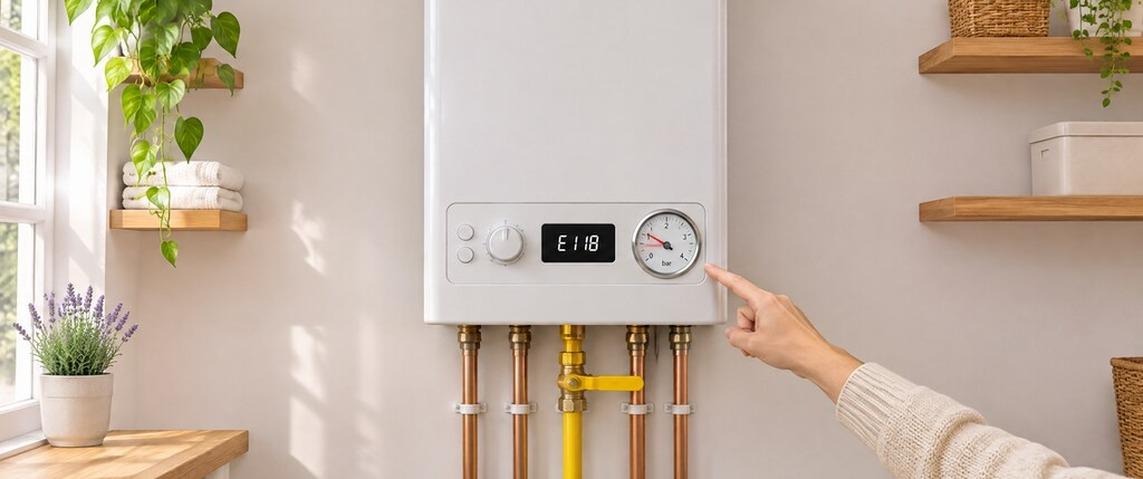
A Potterton fault code is an E-number the boiler shows when its safety checks spot a problem, most often low pressure (E118 or E119), an ignition fault (E133), loss of flame (E128 or E129) or overheating (E110). Note the code, check the pressure gauge, power, gas and, in frost, the condensate pipe, then reset once if your manual allows. If it comes back, or you smell gas, stop and call a Gas Safe registered engineer.
In this post, we'll cover
- Key takeaways
- What’s in this guide
- First: is this an emergency?
- Do this first, whatever the code
- The four Potterton codes people search for most
- Potterton fault code table
- How to reset a Potterton boiler
- The frozen condensate pipe (a winter classic)
- When to stop and call a Gas Safe engineer
- Carbon monoxide: the quiet one
- Potterton lockout at the worst moment?
Your Potterton has thrown up an E-code and stopped. Here’s what the common ones mean, what you can safely check, and where to stop and call a Gas Safe engineer.
You’ve had your Potterton for years. It’s never made a fuss. Then one cold morning the display shows E133 or E119, the radiators stay cold, and suddenly you’re googling things you never thought you’d need to know.
Take heart. A Potterton fault code is the boiler being careful, not dramatic. Ranges such as the Promax and Assure show faults as an E followed by a number, and a handful of them are things a homeowner can look at safely. Most are not, and we’ll be upfront about which is which.
Most people search for these as Potterton fault codes or error codes; they’re the same thing. If the codes look strangely familiar, that’s because Potterton sits in the same boiler group as Baxi, and many of the E-numbers overlap. They’re not guaranteed to mean the same thing on every model though, and the sources we checked don’t agree on every code, so your own manual always has the final say.
Key takeaways
- Low pressure (E118 or E119) is the code homeowners can most often help with. Repressurise first, then restart. In frost, E119 can also point to a frozen condensate pipe on some models.
- E133 is often a gas supply or ignition issue, and in frost a frozen condensate pipe.
- Fan, flue, sensor and circuit board codes, and any overheating code that comes back after one reset, are for a Gas Safe engineer only.
- Sources disagree on a few Potterton codes (E119 and E133 especially), so the manual wins.
- Gas smell or carbon monoxide symptoms: leave and call 0800 111 999.
What’s in this guide
- Is this an emergency?
- Do this first
- The codes people search for most
- Potterton fault code table
- How to reset a Potterton
- The frozen condensate pipe (a winter classic)
- When to call an engineer
- Carbon monoxide
- FAQs
First: is this an emergency?
Smell gas? Act now, read later.
- Open doors and windows and leave the property.
- Don’t switch lights or appliances on or off. No flames.
- If you can reach it safely, turn the gas off at the meter.
- Call the National Gas Emergency Service on 0800 111 999 (free, 24 hours) from outside.
No gas smell? Here’s the system we use for the codes below:
Level | What it means |
Green | A simple check you can do: gauge, power, thermostat, gas supply, frozen condensate pipe, one reset. |
Amber | Fan, flue, sensor or pump faults, an overheat that repeats, or any repeating code. Stop and call a Gas Safe engineer. |
Red | Gas smell or carbon monoxide symptoms. Leave, call 0800 111 999. No troubleshooting. |
Do this first, whatever the code
- Photograph the display. Note the exact code and your model name. On some models, three-digit codes flash in two parts, so E133 shows as E1 then 33. An engineer will thank you.
- Check the pressure gauge. Cold, it should sit at roughly 1 to 1.5 bar.
- Check the basics. Power on? Thermostat and timer calling for heat, with working batteries? Gas hob working? Credit on a prepayment meter?
- Is it freezing outside? A frozen condensate pipe can lock out many condensing boilers. Thaw it with warm (never boiling) water and restart.
- Reset once. If the code returns, stop and call an engineer.
Have boiler or home emergency cover? Call your provider before you book an engineer yourself. With Smart Cover, repairs arranged without our approval may not be covered.
The four Potterton codes people search for most
E118 / E119: low pressure
The system pressure has dropped too low and the boiler has locked out. Restarting alone won’t fix it. It’s common after bleeding radiators. On some models, E119 can also show when the condensate pipe has frozen in cold weather.
Try: top up with the filling loop until the needle is in the green zone (around 1.5 bar), following your manual, then restart.
Stop if: pressure drops again soon after, or suddenly. That suggests a leak. Call a Gas Safe engineer.
E133: ignition fault
The boiler tried to light and couldn’t. A gas supply interruption is a common cause, and in freezing weather a frozen condensate pipe. On some older models the display shows it in two parts, E1 then 33, so an “E1” fault is usually E133.
Try: check the hob and any prepayment meter, thaw a frozen condensate pipe with warm (never boiling) water, then reset once.
Stop if: it repeats. Ignition parts need an engineer.
E128 / E129: loss of flame
The flame went out or wasn’t detected. The causes overlap with E133: gas supply, frozen condensate or ignition parts.
Try: the same basic checks and one reset.
Stop if: it returns, especially with odd smells or noises. Call a Gas Safe engineer.
E110: overheat tripped
The boiler has overheated and cut out. Low pressure, poor circulation or a stuck pump can all contribute.
Try: check the pressure gauge and that radiator valves are open, then reset once.
Stop if: it returns. A repeating E110 needs an engineer.
Potterton fault code table
Potterton shows a long list of E-codes. These are the ones seen most, grouped by type. Treat it as a starting point and confirm in your manual.
Type | Code | Usually means | Your move |
Pressure | E118 / E119 | System pressure low (on some models, E119 can also mean a frozen condensate pipe in cold weather) | Green. Repressurise per your manual, then restart. Dropping again? Amber. |
Pressure | E117 | System pressure too high | Green. Check the gauge against your manual. Staying high? Amber. |
Pressure | E78 | Water pressure sensor fault | Amber. Engineer |
Ignition and gas | E133 | Ignition fault (also linked to a frozen condensate pipe) | Green. Check gas and condensate pipe, reset once. Repeats? Amber. |
Ignition and gas | E128 / E129 | Loss of flame | Green. Same checks. Repeats? Amber. |
Ignition and gas | E09 / E15 | Gas valve wiring or connection fault | Amber. Engineer |
Ignition and gas | E384 | Flame detected when the gas valve is off | Amber. Engineer |
Heat and circulation | E110 | Boiler overheat tripped | Green. Check pressure and radiator valves, reset once. Repeats? Amber. |
Heat and circulation | E109 / E125 / E154 / E193 | Poor circulation or primary flow/circulation faults | Amber. Engineer |
Heat and circulation | E270 | Dry fire | Amber. Engineer |
Fan and flue | E160 / E161 | Fan fault | Amber. Engineer |
Fan and flue | E28 / E53 / E130 / E131 | Flue thermistor, obstruction or flue overheat/thermostat faults | Amber. Engineer |
Sensors | E10 / E20 / E40 / E50 / E164 / E321 | Outdoor, central heating, return or hot water sensor faults | Amber. Engineer |
Circuit board | E151 / E152 / E167 / E168 / E317 / E385 | PCB, lockout, power supply or low voltage faults | Amber. Engineer |
Meanings are common interpretations and vary by model. Where your display shows a code not listed here, use the manual or ask an engineer.
How to reset a Potterton boiler
Potterton resets are model-specific, so check your manual for the exact button and method. The principle is the same across the group: fix the cause first, then reset. For low pressure (E118 or E119), the boiler locks out and restarting alone won’t help; repressurise, then restart. For anything else, reset once. If the code comes back, don’t keep going: repeated restarts on a lockout with no clear cause just repeat the fault.
See also our wider guide to boiler error codes and our checklist for a boiler that won’t fire up.
The frozen condensate pipe (a winter classic)
Condensing boilers drain slightly acidic water through a plastic pipe, usually to the outside. In a hard frost it can freeze and the boiler locks out, often with an ignition-type code such as E133. Gurgling sounds beforehand are a clue.
To thaw it safely: switch the boiler off, find the frozen section (usually the most exposed part of the pipe), and warm it with a hot water bottle, a heat pack or warm water from a watering can. Never boiling water, which can crack the pipe. Then restart. If it keeps freezing, ask an engineer to insulate it or reroute it indoors. And don’t climb an icy ladder to do it yourself.
When to stop and call a Gas Safe engineer
Boilers are sealed gas appliances, and gas work in the UK must be done by someone on the Gas Safe Register. Call when:
- a code returns after one reset, or a different one replaces it
- it relates to the fan, flue, sensors, pump or gas valve, or an overheat code repeats
- there is leaking water, banging or whistling, soot or black marks around the boiler
- the flame, if you can see it, looks mostly yellow or orange rather than steady blue
- fixing it would mean taking the casing off. Always.
Check the ID. Every registered engineer carries a Gas Safe ID card with a photo, and you can verify them on the Gas Safe Register website.
Carbon monoxide: the quiet one
Carbon monoxide has no smell, colour or taste. Symptoms feel like flu without a temperature: headaches, dizziness, nausea, tiredness. If several people at home feel unwell and it eases when you’re out, take it seriously. Fit an audible CO alarm near the boiler and in bedrooms, test it, and if it sounds, open windows, leave and call 0800 111 999. Once you are out, if anyone feels unwell, get medical help: call NHS 111, or 999 if symptoms are severe.
Keeping the boiler healthy helps too: an annual boiler service, bleeding radiators that are cold at the top, and a glance at the gauge once a month. If you have Smart Cover boiler cover, your boiler must have been serviced in the 12 months before a breakdown claim. If the codes keep changing on an older boiler, it’s worth calmly weighing up whether to keep repairing it or replace it. A Gas Safe engineer can give you an honest view of its condition.
Potterton lockout at the worst moment?
Smart Cover boiler cover and home emergency cover are there for the covered breakdowns the checklist can’t fix. Report an emergency any time on our 24/7 Emergency Helpline, 03333 449 247, and we’ll arrange an engineer from our UK network for covered faults. For claims and other enquiries, call 03333 449 559.
Before you rely on cover, know the key terms:
• Cover is for mains gas boilers only. LPG, oil and electric boilers are not covered.
• Your boiler must have been serviced in the 12 months before a breakdown claim.
• There is a waiting period from the start of your policy: 14 days for homeowner policies and 28 days for landlord policies.
• Claims are paid up to the claim limit on your policy schedule.
• Exclusions include wear and tear, sludge, limescale and corrosion, and faults that existed before your policy started. Repairs arranged without our approval may not be covered, so always call us first.
See boiler cover or home emergency cover. Read the policy documents and IPID for full terms. Cover helps with repair costs for covered breakdowns. A gas smell or CO symptoms are always an emergency call to 0800 111 999 first.
Official sources
- Gas Safe Register: find and check registered engineers
- HSE: gas safety in the home
- National Gas Emergency Service: 0800 111 999
- Your Potterton manual, or the manufacturer’s support pages, for model-specific fault code lists.
Keep reading
• Baxi error codes: E133, E118 and more
• Glow-worm error codes: F.22, F.28, F.75 and more
General information only. This guide isn’t a substitute for your boiler manufacturer’s instructions or advice from a Gas Safe registered engineer. Fault code meanings vary by model. Smart Cover is not affiliated with Potterton. This is a marketing communication. Cover is subject to policy terms, limits and exclusions. Reviewed 20 November 2026.
Smart-Cover Insurance Services, Smart Cover and Smart Cover 247 are trading names of Smart-Cover Direct Limited (FRN 600428), an Appointed Representative of City and Commercial Limited (FRN 314346), which is authorised and regulated by the Financial Conduct Authority. The Financial Ombudsman Service can be contacted at www.financial-ombudsman.org.uk.


