
Glow-worm Boiler Error Codes: Complete Guide

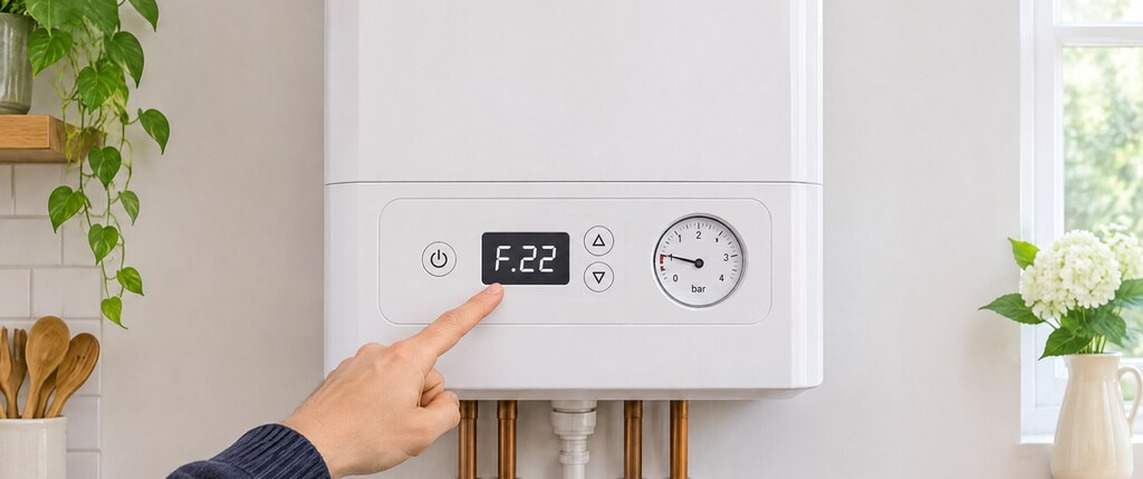
A Glow-worm fault code is an F-number the boiler shows when its safety checks spot a problem, most often low water pressure (F.22), a failed ignition (F.28), a lost flame (F.29) or a pump or pressure fault (F.75). Note the code, check the pressure gauge, power, gas and, in frost, the condensate pipe, then reset once. If it comes back, or you smell gas, stop and call a Gas Safe registered engineer.
In this post, we'll cover
- Key takeaways
- What's in this guide
- First: is this an emergency?
- The four Glow-worm codes people search for most
- Glow-worm fault code table
- How to reset a Glow-worm boiler
- Low pressure and the filling loop
- When to stop and call a Gas Safe engineer
- Carbon monoxide: the quiet one
- Glow-worm lockout at the worst moment?
Your Glow-worm is showing an F-code and has gone quiet. Here's what the common ones mean, what you can safely try, and where to stop and call a Gas Safe engineer.
There's a particular kind of silence when a boiler stops. The radiators tick, the hot tap runs cold, and the little screen on your Glow-worm says F.22. Not exactly helpful.
The good news is that Glow-worm fault codes are usually the boiler being careful rather than broken. Even better, a few of the most common ones, low pressure and ignition problems especially, are things a homeowner can look at safely. The rest should be left to someone on the Gas Safe Register, and we'll be clear about which is which.
Glow-worm shows faults as an F followed by a number, often with a full stop (F.22). Many of the codes will look familiar if you have read about Vaillant boilers: both brands belong to the same group and share a lot of the same fault logic. Always check your own model, though.
Key takeaways
- F.22 is the code homeowners can most often help with, because it usually means low pressure.
- F.28 and F.29 are often a gas supply, ignition or frozen condensate pipe problem. Check, then reset once.
- Overheating, fan, sensor, gas valve and flame signal codes are for a Gas Safe engineer only.
- Glow-worm says resetting can sometimes clear a fault or get the boiler working again temporarily. A returning code means a real fault.
- Gas smell or carbon monoxide symptoms: leave and call 0800 111 999.
What's in this guide
- Is this an emergency?
- Do this first
- The codes people search for most
- Glow-worm fault code table
- How to reset a Glow-worm
- Low pressure and the filling loop
- When to call an engineer
- Carbon monoxide
- FAQs
First: is this an emergency?
Smell gas? Act now, read later.
- Open doors and windows and leave the property.
- Don't switch lights or appliances on or off. No flames.
- If you can reach it safely, turn the gas off at the meter.
- Call the National Gas Emergency Service on 0800 111 999 (free, 24 hours) from outside.
No gas smell? Here is how we sort the codes below:
Level | What it means |
Green | A simple check you can do: gauge, power, thermostat, gas supply, a frozen condensate pipe, one reset. |
Amber | Fan, flue, sensor, pump, overheating or a repeating code. Stop and call a Gas Safe engineer. |
Red | Gas smell or carbon monoxide symptoms. Leave, call 0800 111 999. No troubleshooting. |
Do this first, whatever the code
- Photograph the display. Note the exact code and your model name. An engineer will thank you.
- Check the pressure gauge. When the system is cold, it should sit at roughly 1 to 1.5 bar.
- Check the basics. Power on? Thermostat and timer calling for heat, with working batteries? Gas hob working? Credit on a prepayment meter?
- Is it freezing outside? A frozen condensate pipe can lock out many condensing boilers. Thaw it with warm (never boiling) water and restart.
- Reset once. If the code returns, stop and call an engineer.
Have boiler or home emergency cover? Call your provider before you book an engineer yourself. With Smart Cover, repairs arranged without our approval may not be covered.
The four Glow-worm codes people search for most
F.22: low pressure
The boiler has found the water pressure too low. It is common after bleeding radiators and a regular autumn visitor.
Try: top up with the filling loop to about 1 to 1.5 bar, following your manual.
Stop if: it drops again within days. That suggests a leak.
F.28: failed to ignite
The boiler tried to light and could not. Glow-worm suggests checking that other gas appliances work and a prepayment meter has credit, and in cold weather looking for ice in outdoor condensate pipes.
Try: check the hob and meter, thaw a frozen condensate pipe with warm water, then reset once.
Stop if: it repeats. Ignition parts need an engineer.
F.29: flame lost
The boiler lit, then the flame went out and it could not relight. The checks match F.28.
Try: the same basic checks as F.28 and one reset.
Stop if: it comes back, especially with odd noises or smells.
F.75: pump or pressure
The boiler did not see enough pressure change when the heating pump started. That points at the pump, the pressure sensor or low pressure.
Try: check the gauge is not low and follow the same pressure steps as F.22.
Stop if: it returns. Don't keep topping up. Call an engineer.
Glow-worm fault code table
Glow-worm uses a lot of codes, and the exact meaning can differ between ranges. These are the ones most often seen, grouped by type. Treat the table as a starting point and confirm in your manual.
Type | Code | Usually means | Your move |
Pressure | F.22 | Low water pressure | Green. Check the gauge, repressurise per your manual. Dropping again? Amber |
Pressure | F.75 | Pressure change too low when the pump starts | Green. Check the gauge. Repeats? Amber |
Ignition | F.28 | Boiler failed to ignite | Green. Check gas, meter credit, condensate pipe in frost. Reset once. Repeats? Amber |
Ignition | F.29 | Flame lost and failed to relight | Green. Same checks. Repeats? Amber |
Safety | F.20 | Safety thermal cut-out has shut the boiler off | Amber. Check pressure, that radiator valves are open, and for airlocks. Repeats? Engineer |
Safety | F.23 / F.24 | Flow/return temperature difference too great, or temperature rising too fast | Amber. Engineer |
Safety | F.27 | Flame signal detected while the burner is off | Amber. Engineer. Can be dangerous |
Fan | F.32 | Fan fault | Amber. Engineer |
Sensors | F.0 / F.1 / F.10 / F.11 | Flow or return temperature sensor interrupted or short-circuited | Amber. Engineer |
Sensors | F.72 / F.83 / F.84 | Temperature spread invalid, little temperature rise, or implausible readings | Amber. Engineer |
Electrics | F.70 / F.88 | Device specific number wrong, or gas valve fault (on some ranges) | Amber. Engineer |
Meanings are common interpretations and vary by model and range. Where your display shows a code not listed here, use the manual or ask an engineer.
How to reset a Glow-worm boiler
Glow-worm says that resetting your boiler can often clear a fault or get it working again for a while. The exact steps depend on the model, so check your user manual (Glow-worm publishes manuals on its website). In general, you press and hold the reset button on the control panel, release it, and wait for the boiler to restart.
The rule is once. A reset is a second chance, not a repair. If the code comes back, see our wider guide to boiler error codes, or our checklist for a boiler that won't fire up.
Low pressure and the filling loop
Since F.22 and F.75 are the codes you are most likely to meet, it's worth knowing the basics. With the system cold, the gauge should read roughly 1 to 1.5 bar. If it's lower, you can top it up using the filling loop (the flexible braided hose under the boiler) by opening the valves slowly until the needle reaches about 1.5 bar, then closing them fully. Follow your manual rather than a stranger's video, because layouts differ.
If pressure falls again within a few days, don't keep topping it up. That points to a leak or a failing expansion vessel, and an engineer should find it.
When to stop and call a Gas Safe engineer
Boilers are sealed gas appliances, and gas work in the UK must be done by someone on the Gas Safe Register. Call when:
- a code returns after one reset, or a different one replaces it
- it relates to the fan, flue, sensors, pump, overheating or gas valve
- there is leaking water, banging or whistling, soot or black marks around the boiler
- the flame, if you can see it, looks mostly yellow or orange rather than steady blue
- fixing it would mean taking the casing off. Always.
Check the ID. Every registered engineer carries a Gas Safe ID card with a photo, and you can verify them on the Gas Safe Register website. If you have boiler cover, call your provider first so they can arrange the engineer.
Carbon monoxide: the quiet one
Carbon monoxide has no smell, colour or taste. Symptoms feel like flu without a temperature: headaches, dizziness, nausea, tiredness. If several people at home feel unwell and it eases when you're out, take it seriously. Fit an audible CO alarm near the boiler and in bedrooms, test it, and if it sounds, open windows, leave and call 0800 111 999.
Keeping the boiler healthy helps too: an annual boiler service, bleeding radiators that are cold at the top, and a glance at the gauge once a month. If you have Smart Cover boiler cover, your boiler must have been serviced in the 12 months before a breakdown claim. If the codes keep changing on an older boiler, it's worth calmly weighing up whether to keep repairing it or replace it. A Gas Safe engineer can give you an honest view of its condition.
Glow-worm lockout at the worst moment?
Smart Cover boiler cover and home emergency cover are there for the covered breakdowns the checklist can't fix. Report an emergency any time on our 24/7 Emergency Helpline, 03333 449 247, and we'll arrange an engineer from our UK network for covered faults. For claims and other enquiries, call 03333 449 559.
Before you rely on cover, know the key terms:
- Cover is for gas boilers only. Oil, LPG and electric boilers are not covered.
- Your boiler must have been serviced in the 12 months before a breakdown claim.
- There is a waiting period from the start of your policy: 14 days for homeowner policies and 28 days for landlord policies.
- Claims are paid up to the claim limit on your policy schedule.
- Exclusions include wear and tear, sludge and limescale, faults that existed before your policy started, and repairs arranged without contacting us first.
See boiler cover or home emergency cover. Read the policy documents and IPID for full terms. Cover helps with repair costs for covered breakdowns. A gas smell or CO symptoms are always an emergency call to 0800 111 999 first.
Official sources
- Gas Safe Register: find and check registered engineers
- HSE: gas safety in the home
- National Gas Emergency Service: 0800 111 999
- Glow-worm's own fault code pages and user manuals on glow-worm.co.uk. For a code not listed, use the helpline printed there.
Keep reading
General information only. This guide isn't a substitute for your boiler manufacturer's instructions or advice from a Gas Safe registered engineer. Fault code meanings vary by model. Smart Cover is not affiliated with Glow-worm. This is a marketing communication. Cover is subject to policy terms, limits and exclusions. Reviewed 11 November 2026.
Smart-Cover Insurance Services, Smart Cover and Smart Cover 247 are trading names of Smart-Cover Direct Limited (FRN 600428), an Appointed Representative of City and Commercial Limited (FRN 314346), which is authorised and regulated by the Financial Conduct Authority. The Financial Ombudsman Service can be contacted at www.financial-ombudsman.org.uk.


